






















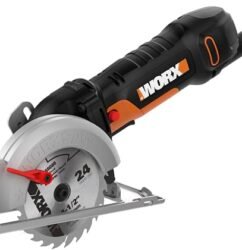

Reciprocating Saw vs Circular Saw: Uses, Pros, Cons & Which One to Choose

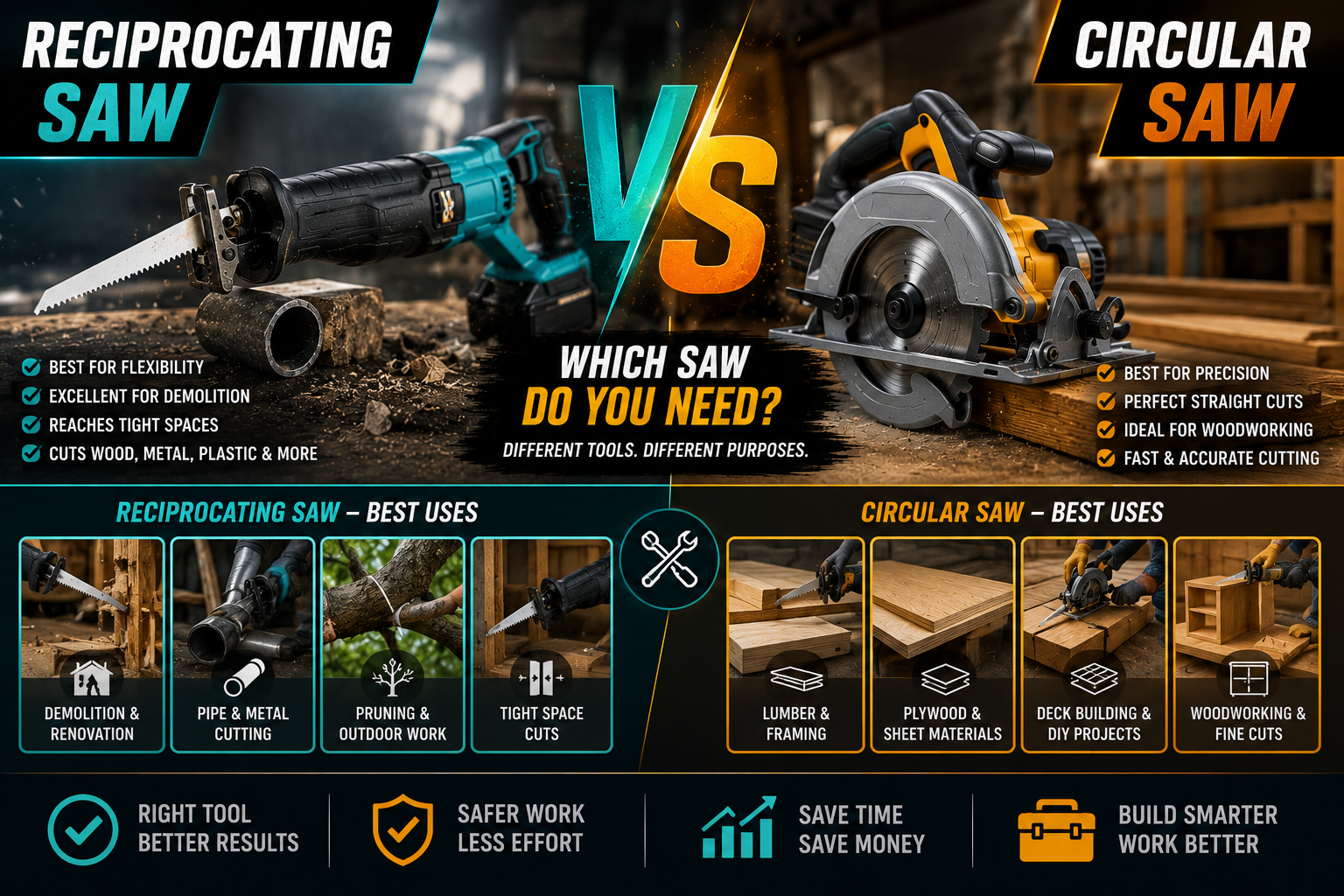
When you are building a DIY tool collection, choosing between a reciprocating saw and a circular saw can be confusing. Both are powerful handheld cutting tools, both can cut wood, and both are available in corded and cordless versions.
But they are designed for very different types of work.
A circular saw is primarily a controlled cutting tool, making it particularly useful for straight cuts through lumber, plywood, boards, and sheet materials.
A reciprocating saw is primarily a versatile utility and demolition tool, making it useful for rough cutting, remodeling, pipe cutting, pruning, dismantling materials, and reaching difficult areas.
So, which one should you buy?
The answer depends on the project.
If your priority is accurate, straight cutting, a circular saw is usually the better choice. If you need flexibility, demolition capability, or the ability to cut in awkward locations, a reciprocating saw may be more useful.
This guide compares the two tools by their real-world applications, advantages, limitations, cutting ability, handling, portability, blade selection, and overall value.
Reciprocating Saw vs Circular Saw: Quick Comparison
| Feature | Reciprocating Saw | Circular Saw |
|---|---|---|
| Main purpose | Demolition and versatile cutting | Straight and controlled cutting |
| Blade movement | Back and forth | Rotating |
| Straight cuts | Moderate | Excellent |
| Precision | Moderate | High |
| Demolition | Excellent | Good |
| Woodworking | Good | Excellent |
| Plywood | Possible | Excellent |
| Pipe cutting | Excellent | Limited |
| Pruning | Excellent with suitable blade | Poor choice |
| Tight spaces | Excellent | Limited |
| Blade variety | Very versatile | Material-specific |
| Rough cutting | Excellent | Good |
| Long straight cuts | Limited | Excellent |
| Outdoor mobility | Excellent with cordless model | Excellent with cordless model |
The most important distinction is therefore not raw power.
It is how the tool transfers that power into the material.
What Is a Reciprocating Saw?
A reciprocating saw uses a narrow blade that moves rapidly backward and forward.
This simple movement makes the tool extremely adaptable.
Instead of relying on one large circular blade, you can install different blades designed for different materials and applications.
Depending on the blade and tool, a reciprocating saw can be used for:
- Wood
- Metal
- Plastic
- PVC
- Drywall
- Branches
- Pipes
- Construction materials
- Demolition work
The design is particularly useful when the cut does not need to be perfectly straight.
It is often the tool you reach for when the priority is simply to cut through something that is in the way.
What Is a Circular Saw?
A circular saw uses a rotating circular blade mounted beneath a protective guard.
The tool’s base plate rests on the material while the user guides the saw along a cutting line.
Circular saws are commonly used for:
- Lumber
- Plywood
- Boards
- Decking
- Framing
- Flooring
- Shelving
- Construction
- Woodworking
- Home improvement
The circular blade and stable base make the tool particularly useful when you need predictable, straight cuts.
The Core Difference Between the Two Tools
The simplest way to remember the difference is:
Circular saw: cut accurately.
Reciprocating saw: cut flexibly.
A circular saw is designed around controlled movement through a workpiece.
A reciprocating saw is designed around access and versatility.
That difference affects almost every other part of the comparison.
Which Tool Is Better for Straight Cuts?
Circular Saw
If you need to cut a board in a straight line, a circular saw is generally the better tool.
The base plate gives you a stable platform, while the blade follows the direction of travel.
With a guide or straightedge, you can improve consistency even further.
A reciprocating saw can cut the same board, but maintaining a long, perfectly straight line is more difficult.
The blade is constantly moving back and forth, and the tool does not provide the same type of support.
Best circular saw applications include:
- Long cuts
- Plywood
- Lumber
- Sheet materials
- Deck boards
- Framing
- Construction cuts
If accuracy matters, the circular saw has the advantage.
Which Tool Is Better for Demolition?
Reciprocating Saw
Demolition is one of the strongest use cases for a reciprocating saw.
During renovation, you may need to remove:
- Old wood
- Pipes
- Wall sections
- Cabinet components
- Fastened materials
- Metal brackets
- Damaged structures
In these situations, you are often not trying to produce a beautiful finished edge.
You are trying to remove material quickly and safely.
The narrow blade makes it possible to cut into awkward areas where a circular saw may be difficult to position.
Which Tool Is Better for Cutting Wood?
Both tools can cut wood effectively.
The right choice depends on the type of cut.
Use a circular saw for:
- Plywood
- Long boards
- Straight cuts
- Repeatable cuts
- Deck construction
- Framing
- Furniture-related work
Use a reciprocating saw for:
- Rough cuts
- Demolition
- Removing old lumber
- Cutting in awkward positions
- Dismantling wooden structures
For precision woodworking, the circular saw is generally the stronger choice.
For rough or removal work, the reciprocating saw is often more practical.
Which Tool Is Better for Plywood?
Circular Saw
Plywood is one of the clearest examples of where a circular saw has an advantage.
The flat base and rotating blade make it easier to follow a long cutting line.
A reciprocating saw can physically cut plywood, but it is not the natural tool for producing long, clean, controlled cuts.
If you frequently work with sheet materials, a circular saw should be high on your DIY tool list.
Which Tool Is Better for Cutting Pipes?
Reciprocating Saw
A reciprocating saw is often much more convenient for pipe cutting.
The narrow blade can be positioned around pipes and other components in tight areas.
This makes it useful for:
- Plumbing projects
- Bathroom renovation
- Kitchen renovation
- PVC cutting
- Metal pipe cutting
- Removing old pipe sections
The correct blade is essential.
A wood-cutting blade should not be used simply because it happens to fit the saw.
Choose a blade designed for the material being cut.
Which Tool Is Better for Pruning?
Reciprocating Saw
With a suitable pruning blade, a reciprocating saw can be a useful outdoor cutting tool.
It can help with branches that are too large for ordinary hand pruners.
A cordless reciprocating saw is particularly convenient because you do not have to manage a power cable around trees, fences, or garden areas.
However, pruning should be performed carefully.
Consider branch stability, falling material, overhead hazards, and your ability to maintain control before starting a cut.
Which Tool Is Better for Tight Spaces?
Reciprocating Saw
This is one of the reciprocating saw’s biggest advantages.
Its narrow blade can reach areas where a circular saw may simply not fit.
For example, you may need to cut:
- Behind a cabinet
- Between framing members
- Around pipes
- Near an existing structure
- Inside a renovation opening
- Beneath a difficult-to-reach component
The circular saw needs room for its circular blade and base.
The reciprocating saw can be much more flexible.
Which Tool Is Better for Metal?
Reciprocating Saw for Versatility
With the correct blade, a reciprocating saw can cut many metal components.
It can be useful for:
- Metal pipes
- Studs
- Brackets
- Bolts
- Hardware
- Thin metal sections
- Demolition
Circular saws can also be used for certain metal applications when the tool and blade are specifically designed for that purpose.
However, for general DIY situations where you need a flexible metal-cutting option, the reciprocating saw can be easier to adapt.
Always verify the tool and blade manufacturer’s intended application.
Which Tool Is Better for Precision?
Circular Saw
If the quality of the finished cut matters, the circular saw generally wins.
Examples include:
- Building furniture
- Cutting shelves
- Preparing boards
- Cutting plywood
- Building a deck
- Framing
- Making repeatable dimensions
A reciprocating saw is not primarily a precision instrument.
That does not make it inferior.
It simply means its strengths are different.
Reciprocating Saw Pros
The reciprocating saw has several advantages that make it valuable in a DIY toolkit.
Excellent versatility
One tool can handle many materials when the appropriate blades are available.
Great for demolition
It can quickly remove unwanted material.
Works in tight spaces
The narrow blade makes awkward cuts possible.
Useful outdoors
A cordless model is particularly convenient for pruning and exterior work.
Wide blade selection
Different blades can be used for wood, metal, plastic, pruning, and demolition.
Easy to adapt
Changing the blade can transform the tool for a completely different application.
Reciprocating Saw Cons
No tool is perfect.
Lower precision
Long, straight cuts are more difficult.
Significant vibration
The blade’s back-and-forth movement naturally produces vibration.
Rougher cuts
The finished edge may not be as clean as a controlled circular-saw cut.
Blade selection matters
Using the wrong blade can significantly reduce performance.
Can be tiring
Extended cutting may become uncomfortable depending on the tool’s weight, vibration, and ergonomics.
Circular Saw Pros
Excellent straight cuts
This is its biggest strength.
Strong woodworking capability
It is highly useful for lumber and sheet materials.
Good cutting consistency
A guide can improve repeatability.
Fast material removal
The rotating blade can cut through suitable materials efficiently.
Bevel cutting
Many circular saws support angled cuts.
Broad DIY applications
The tool can be useful for construction, woodworking, renovation, and home improvement.
Circular Saw Cons
Less useful in tight spaces
The circular blade needs adequate clearance.
Not ideal for demolition
It can perform some demolition tasks, but it is not as flexible as a reciprocating saw.
Not designed for pruning
It is generally the wrong choice for cutting branches.
More setup may be required
Straight, accurate cuts often benefit from careful measurement and guides.
Blade selection still matters
The wrong circular blade can produce poor results or damage the material.
Which Tool Is Easier to Control?
Control depends on the job.
A circular saw can feel very stable when the base plate is supported correctly on a workpiece.
A reciprocating saw can feel more dynamic because of the blade’s rapid movement.
For beginners, neither should be considered automatically easy.
The user should learn:
- How to hold the tool
- How to support the material
- How to select the correct blade
- How to maintain a stable position
- How to avoid hidden hazards
- How to stop the tool safely
Practice and proper technique matter more than choosing one tool simply because it appears easier.
Which Tool Is Better for Beginners?
For a beginner who mainly wants to build shelves, cut boards, work with plywood, or perform basic woodworking, a circular saw can be a useful first cutting tool.
For a beginner focused on remodeling, demolition, pipe cutting, or outdoor pruning, a reciprocating saw may be more useful.
The decision should therefore be based on the projects you actually expect to perform.
Which Tool Is More Versatile?
Reciprocating Saw
In terms of the variety of situations it can handle, the reciprocating saw generally has the edge.
One tool can potentially be adapted for:
- Wood
- Metal
- Plastic
- PVC
- Pruning
- Demolition
But versatility does not mean it performs every task equally well.
A tool can be capable of cutting something without being the best tool for that particular cut.
This distinction is important.
Which Tool Gives a Cleaner Cut?
Circular Saw
A circular saw is generally better when the finished edge matters.
For example, if you are making a shelf, cutting plywood for furniture, or preparing lumber for a visible installation, you typically want more control over the cut.
A reciprocating saw is better suited to jobs where the cut will be hidden, trimmed later, or where removal is more important than appearance.
Which Tool Is Better for Home Renovation?
Both
Home renovation is where owning both can make sense.
A renovation project may involve:
- Removing old cabinets
- Cutting lumber
- Cutting plywood
- Removing pipes
- Opening wall sections
- Trimming framing
- Cutting brackets
- Dismantling old structures
You might use a reciprocating saw to remove something and a circular saw to prepare replacement material.
They complement each other rather than compete.
Which Tool Is Better for Construction?
Depends on the task
For framing and straight lumber cuts:
Circular saw.
For demolition and difficult cutting:
Reciprocating saw.
For construction professionals, the most efficient solution is often having access to both.
Trying to force one tool to perform every cutting task can reduce efficiency.
Cordless Reciprocating Saw vs Cordless Circular Saw
Cordless versions of both tools provide excellent mobility.
The difference is still their intended function.
Cordless circular saw
Best suited to:
- Straight cuts
- Lumber
- Plywood
- Decking
- Framing
- Outdoor construction
Cordless reciprocating saw
Best suited to:
- Demolition
- Pipes
- Pruning
- Remodeling
- Rough cutting
- Tight spaces
If you already own one cordless tool, consider whether the next purchase fills a gap in your toolkit.
Which One Should You Buy First?
Use your project list to decide.
Buy a circular saw first if you plan to:
- Build shelves
- Cut plywood
- Work with lumber
- Build decks
- Perform woodworking
- Make straight cuts
Buy a reciprocating saw first if you plan to:
- Remodel
- Demolish
- Cut pipes
- Prune branches
- Remove old structures
- Work in tight areas
Buy both if you:
- Frequently renovate
- Work on construction projects
- Perform many DIY tasks
- Want a complete cutting toolkit
- Need both precision and flexibility
What About a Jigsaw?
A jigsaw is another tool worth considering when building a cutting toolkit.
A jigsaw is particularly useful for curved cuts, detailed shapes, and certain controlled cuts in wood and other materials.
This means the three tools can serve different roles:
Circular saw: straight cuts.
Reciprocating saw: rough, flexible, demolition cutting.
Jigsaw: curved and detailed cuts.
Understanding these roles can help prevent buying the wrong tool for a particular project.
How Blade Choice Changes Performance
The blade can be just as important as the tool.
For reciprocating saws, blade choices may include:
- Wood blades
- Metal blades
- Demolition blades
- Pruning blades
- Bi-metal blades
- Specialized blades
For circular saws, blade characteristics such as tooth design, tooth count, diameter, and intended material can affect the result.
Never assume that a blade designed for one material is suitable for another.
Always check compatibility and intended use.
Which Tool Is Better Value for Money?
The answer depends on how you use it.
A circular saw can offer excellent value if you regularly cut lumber and sheet materials.
A reciprocating saw can offer excellent value if you regularly remodel, demolish, prune, or work around pipes.
The best value is not necessarily the cheapest purchase.
It is the tool that solves the problems you actually encounter.
A tool that costs slightly more but gets used frequently can provide better value than a cheaper tool that does not suit your projects.
Common Buying Mistakes
Choosing Based Only on Power
More power does not automatically mean a better tool.
Ignoring Ergonomics
A powerful tool that is uncomfortable can become frustrating to use.
Buying Without Blades
Remember that blades are part of the overall cost.
Choosing the Wrong Tool for Precision Work
A reciprocating saw can cut wood, but that does not make it the best woodworking saw.
Choosing the Wrong Tool for Demolition
A circular saw can cut wood, but demolition often benefits from the flexibility of a reciprocating saw.
Ignoring Battery Compatibility
If buying cordless tools, consider the battery platform you want to build around.
A Simple Real-World Decision Guide
Imagine you have five projects.
Project 1: Build a wooden bookshelf
Circular saw
You need controlled straight cuts.
Project 2: Remove an old wooden cabinet
Reciprocating saw
You need fast dismantling rather than perfect cuts.
Project 3: Cut a PVC pipe behind a cabinet
Reciprocating saw
The narrow blade and flexible positioning are useful.
Project 4: Cut plywood for a workbench
Circular saw
Straight and repeatable cuts are important.
Project 5: Cut branches in the backyard
Reciprocating saw with a suitable pruning blade
Portability and flexible cutting are useful.
This illustrates why neither tool can completely replace the other.
Our Buying Recommendation
For most homeowners, the decision should start with the type of work they perform most often.
If your projects are primarily woodworking and construction, start with a circular saw.
If your projects are primarily renovation, demolition, plumbing, and outdoor cutting, start with a reciprocating saw.
If you expect to perform both types of work regularly, owning both can be a worthwhile investment.
And if you are building a cordless toolkit, consider selecting tools that share a compatible battery ecosystem whenever practical.
Final Verdict
The circular saw and reciprocating saw are not really substitutes for each other.
They solve different cutting problems.
Choose a circular saw when you need:
- Straight cuts
- Controlled cutting
- Plywood cutting
- Lumber cutting
- Construction work
- Woodworking
- Repeatable results
Choose a reciprocating saw when you need:
- Demolition
- Rough cutting
- Pipe cutting
- Pruning
- Remodeling
- Tight-space access
- Flexible material cutting
If you are building a serious DIY toolkit, having both can be one of the most useful combinations you can make.
The smartest approach is not to ask which tool is universally better.
Ask:
“Which tool is better for the job in front of me?”
That question will almost always lead to a better buying decision.
Frequently Asked Questions
What is better, a reciprocating saw or circular saw?
Neither is universally better. A circular saw is generally better for straight, controlled cuts, while a reciprocating saw is better for demolition, rough cutting, pipes, pruning, and difficult access.
Can a reciprocating saw make straight cuts?
Yes, but it is generally harder to produce long, highly precise straight cuts compared with a circular saw.
Can a circular saw be used for demolition?
It can handle certain demolition tasks, but a reciprocating saw is usually more convenient for rough dismantling and cutting in awkward areas.
Can a reciprocating saw replace a circular saw?
It can perform some of the same cutting tasks, but it cannot fully replace a circular saw when precision and long straight cuts are important.
Can a circular saw cut pipes?
Some circular saws and specialized blades can handle certain pipe-cutting applications, but a reciprocating saw is generally more versatile for this type of work.
Which saw is better for plywood?
A circular saw is generally the better choice for plywood because it is designed for controlled, straight cutting.
Which saw is better for tree branches?
A reciprocating saw fitted with a suitable pruning blade is generally more practical for branches.
Which saw is better for home renovation?
Both can be useful. A reciprocating saw is excellent for demolition and removal, while a circular saw is useful for preparing new lumber, plywood, and other materials.
Which saw should a beginner buy first?
Choose a circular saw if you mainly want to work with lumber and plywood. Choose a reciprocating saw if renovation, demolition, pipes, or pruning are more important to you.
Do I need both saws?
If you perform a wide range of DIY and home improvement projects, owning both can provide much greater flexibility.
Related SmallEasyTools Guides
Continue building your DIY tool knowledge with these related guides:
- Best Cordless Reciprocating Saws for DIY & Home Projects
- Circular Saw vs. Reciprocating Saw: Which One Do You Need?
- Best Circular Saws for DIY Woodworking & Home Improvement
- Cordless vs. Corded Power Tools: Which Is Better for DIY and Home Projects?
- Best Drill Bits for Concrete, Brick, Masonry & Tile
You can also browse the relevant Power Tools collection on SmallEasyTools to compare available products.
Safety and Responsible Use
Both circular saws and reciprocating saws are powerful tools that can cause serious injury.
Always read the manufacturer’s instructions before operating a power tool. Use suitable eye and hearing protection, secure the workpiece, inspect the blade before use, maintain a stable working position, and keep your hands away from the cutting area.
When cutting walls, pipes, framing, or other concealed areas, be aware of possible electrical wiring, plumbing, structural components, and other hidden hazards.
Never use a damaged tool or blade.
Affiliate Disclosure
SmallEasyTools may earn a commission when you purchase products through qualifying affiliate links. This does not increase the price you pay and helps support the website and its content.