
























Cordless vs Corded Power Tools: Which Is Better for DIY and Home Projects?

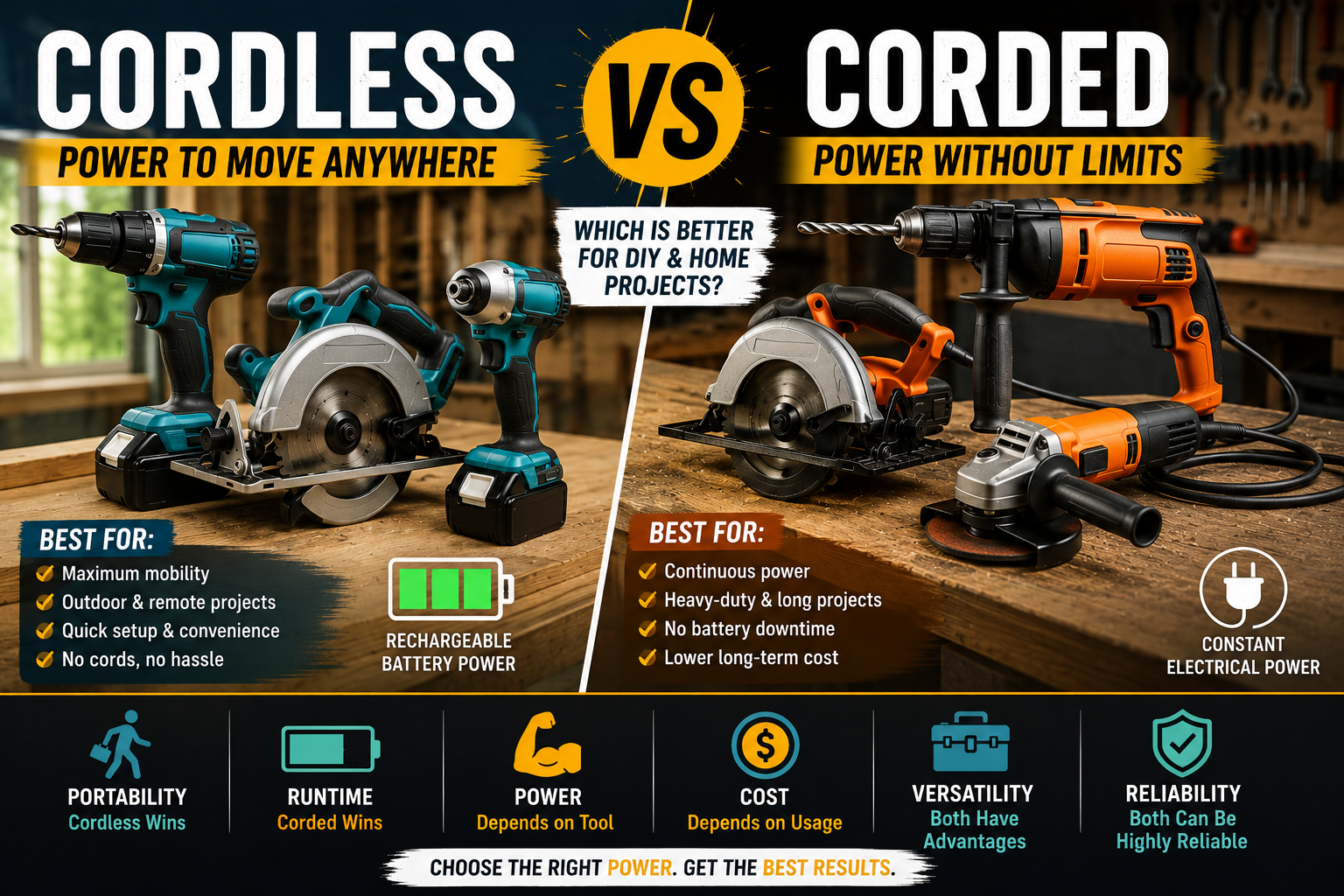
Choosing between cordless and corded power tools can be surprisingly difficult, especially if you are building your first DIY toolkit.
Both types can be powerful, reliable, and useful for home improvement. The real difference is how they receive power and how that affects portability, runtime, convenience, weight, cost, and the type of work you can comfortably perform.
A cordless drill can be convenient when you are moving around the house. A corded sander may make more sense when you are working continuously in a workshop. A cordless circular saw can be excellent for outdoor projects, while a corded model can be convenient when you have a fixed workspace and uninterrupted electricity.
So, which is better?
Cordless power tools are generally better for mobility, convenience, and working in locations without easy access to electricity. Corded power tools are often better for continuous work where consistent electrical power is available.
Neither option is automatically better for everyone.
The right choice depends on your projects, workspace, frequency of use, budget, and whether you already own tools that share the same battery platform.
This guide explains the differences between cordless and corded power tools so you can make a smarter buying decision.
Cordless vs Corded Power Tools at a Glance
| Feature | Cordless Power Tools | Corded Power Tools |
|---|---|---|
| Portability | Excellent | Limited |
| Power source | Rechargeable battery | Electrical outlet |
| Mobility | Excellent | Restricted by cable |
| Continuous runtime | Battery dependent | Excellent |
| Setup | Quick | Requires power connection |
| Outdoor use | Very convenient | Requires suitable power access |
| Workshop use | Excellent | Excellent |
| Long projects | Depends on batteries | Very convenient |
| Weight | Battery can add weight | Often lighter without battery |
| Cable management | None | Required |
| Initial tool cost | Varies | Often competitive |
| Battery ecosystem | Important consideration | Not applicable |
| Best for | Mobile DIY and varied locations | Continuous workshop use |
The table gives you the basic difference, but the best choice becomes clearer when you look at how each type performs in real-world situations.
What Are Cordless Power Tools?
Cordless power tools operate using rechargeable batteries rather than a direct connection to an electrical outlet.
Modern cordless tools are available for almost every common DIY application.
Examples include:
- Cordless drills
- Impact drivers
- Circular saws
- Reciprocating saws
- Jigsaws
- Sanders
- Angle grinders
- Rotary tools
- Blowers
- Trimmers
- Screwdrivers
- Multi-tools
The biggest advantage is freedom.
You can take the tool from your workshop to your driveway, backyard, garage, construction site, or another room without worrying about where the nearest outlet is located.
For homeowners, that convenience can be more important than maximum continuous power.
What Are Corded Power Tools?
Corded power tools receive electricity directly from an electrical outlet.
They are common in workshops, garages, construction environments, and other locations where reliable access to electricity is available.
Common corded tools include:
- Drills
- Circular saws
- Sanders
- Grinders
- Reciprocating saws
- Jigsaws
- Routers
- Table saws
- Bench grinders
- Shop vacuums
The main advantage is that you do not have to stop working because a battery needs to be recharged.
As long as a suitable electrical supply is available, the tool can continue operating.
What Is the Biggest Difference Between Cordless and Corded Tools?
The biggest difference is simple:
Cordless tools prioritize freedom of movement.
Corded tools prioritize continuous access to electrical power.
Everything else follows from this basic difference.
A cordless tool needs a battery, which means you need to consider:
- Battery capacity
- Charging time
- Number of batteries
- Battery compatibility
- Replacement cost
- Runtime
A corded tool does not have these battery-related considerations, but you need to manage:
- Power cables
- Extension cords
- Outlet locations
- Cable positioning
- Outdoor power access
Neither system eliminates inconvenience completely.
They simply move the inconvenience to different parts of the workflow.
Why Are Cordless Power Tools So Popular?
The popularity of cordless tools comes largely from convenience.
Imagine you need to install a few shelves.
With a cordless drill, you can pick up the tool and start working immediately.
You do not need to find an outlet or drag an extension cable across the room.
The same benefit becomes even more noticeable outdoors.
If you are building a garden structure, repairing a fence, assembling outdoor furniture, or working on a deck, cordless equipment can make moving around significantly easier.
Major advantages include:
- Excellent portability
- Quick setup
- No power cable
- Easy outdoor use
- Convenient storage
- Flexible working positions
- Easy movement between work areas
For many homeowners, these advantages make cordless tools the preferred option for everyday DIY.
Are Corded Power Tools More Powerful?
Not necessarily.
This is one of the most common assumptions about power tools.
A corded tool has access to continuous electrical power, but that does not automatically mean every corded tool will outperform every cordless tool.
Modern cordless power tools can provide impressive performance, especially when paired with an appropriate battery and motor system.
The better question is:
Does the tool provide enough performance for your application?
For light DIY work, portability may be more valuable than maximum continuous power.
For demanding applications, however, continuous electrical operation can be a major advantage.
Always compare the specifications and intended application of individual models rather than assuming cordless or corded automatically determines performance.
Battery Runtime: The Biggest Cordless Limitation
The most obvious limitation of cordless tools is battery runtime.
Every battery has a finite amount of stored energy.
How long it lasts depends on factors such as:
- Tool type
- Battery capacity
- Material being worked on
- Workload
- Operating speed
- Tool efficiency
- Temperature
- Cutting or drilling resistance
For example, a cordless drill performing occasional light drilling may run for a long time on a suitable battery.
A high-load saw cutting thick material may consume energy much faster.
This is why battery capacity matters when choosing cordless tools.
How Many Batteries Do You Need?
If you only use cordless tools occasionally, one battery may be enough.
For frequent DIY work, having two compatible batteries can be much more convenient.
You can use one battery while the other charges.
For a larger tool collection, several batteries may become useful.
However, buying extra batteries for every individual tool can become expensive.
This is where battery ecosystems become important.
What Is a Cordless Battery Platform?
A battery platform is a family of compatible tools designed to use batteries from the same system.
For example, if you own a compatible cordless drill and circular saw from the same platform, you may be able to use the same battery with both tools.
This can provide a major financial advantage.
Instead of purchasing a battery and charger with every tool, you may be able to purchase additional bare tools and share your existing batteries.
Always verify compatibility before assuming that two tools use the same battery.
Similar-looking battery systems are not necessarily interchangeable.
Why Cordless Battery Platforms Matter for DIYers
Imagine you want to build a basic cordless toolkit.
You might eventually need:
- Drill
- Impact driver
- Circular saw
- Reciprocating saw
- Oscillating tool
- Sander
Buying each tool with a separate battery and charger can significantly increase the total cost.
A compatible battery ecosystem can make expanding your toolkit more economical.
This is one of the most important things to consider before choosing your first cordless tool.
Instead of asking only:
“Which drill should I buy?”
also ask:
“Which battery platform do I want to build around?”
That decision can affect your future purchases.
Corded Tools and Continuous Work
Corded tools have one major advantage that is difficult to ignore:
They do not depend on battery runtime.
If you are sanding a large surface, cutting material continuously, drilling for an extended period, or performing workshop tasks for hours, a corded tool can be extremely convenient.
You can keep working without stopping to replace or recharge a battery.
For fixed workshops, this can make corded tools particularly practical.
Are Corded Tools Better for Workshops?
They can be.
If your tools are mainly used in a garage or workshop where electrical outlets are readily available, corded equipment can provide a simple and reliable workflow.
You do not have to maintain several charged batteries.
You also do not need to decide whether enough battery capacity remains for the next job.
This is especially useful for tools that consume significant power during long sessions.
Are Cordless Tools Better for Outdoor Projects?
In many situations, yes.
Outdoor projects can make extension cords inconvenient.
You may be working:
- In a backyard
- On a deck
- Near a fence
- In a garden
- On a roof
- At a remote construction area
- Away from the house
A cordless tool allows you to move naturally without dragging a cable behind you.
For outdoor work, this freedom can save time and make the overall project more comfortable.
Cordless vs Corded Circular Saws
Circular saws are a good example of where the choice depends heavily on your working environment.
A cordless circular saw is useful when you need to move around a project site or work away from an outlet.
A corded circular saw can be useful when you are performing many cuts in a workshop or construction area with convenient electrical access.
If you are mainly building shelves, cutting lumber, or performing occasional home repairs, cordless can be attractive because of its convenience.
If you are making repeated cuts for a large project in one location, corded operation may be more convenient.
For a deeper look at choosing a circular saw, see our guide to Best Circular Saws for DIY Woodworking & Home Improvement.
Cordless vs Corded Reciprocating Saws
Reciprocating saws are often used for demolition, remodeling, pruning, and cutting in awkward locations.
That makes portability particularly valuable.
A cordless reciprocating saw can be convenient for:
- Cutting branches
- Outdoor renovation
- Demolition
- Plumbing work
- Remodeling
- Cutting in difficult locations
A corded reciprocating saw can still be useful when performing extended work near a reliable electrical supply.
If portability is a major priority, cordless generally has the advantage.
Our guide to Best Cordless Reciprocating Saws for DIY & Home Projects explains what to look for in this type of tool.
Cordless vs Corded Drills
Drills are probably one of the clearest examples of why cordless tools are so popular.
A cordless drill is easy to carry around the house.
You can use it to:
- Assemble furniture
- Install shelves
- Drill pilot holes
- Install hardware
- Perform repairs
- Work in tight areas
For most everyday household tasks, the convenience of a cordless drill can outweigh the need for continuous power.
Corded drills still have their place, particularly for heavy-duty or extended drilling applications.
But for general homeowners, cordless drills are often the more convenient starting point.
Cordless vs Corded Sanders
Sanding can involve long periods of continuous operation.
This is where the difference becomes more interesting.
A cordless sander provides excellent freedom of movement, especially when working outdoors or in areas without convenient electrical access.
A corded sander can be attractive for workshop users who expect long sessions and do not want to worry about battery runtime.
For occasional furniture refinishing, either option may work well.
For extended workshop sanding, corded operation can be very practical.
Cordless vs Corded Angle Grinders
Angle grinders can place significant demands on their power source.
Cordless grinders provide excellent portability for metalwork, repairs, and outdoor tasks.
However, heavy continuous grinding can consume battery energy quickly.
A corded grinder can therefore be attractive for workshop users who expect prolonged operation.
When choosing between the two, consider not only power but also how long you expect each session to last.
Which Is Better for Beginners?
For many beginners, cordless tools are easier to integrate into a home toolkit.
There is no cable to manage and setup is usually straightforward.
However, beginners should not assume cordless means safer.
Both cordless and corded tools can cause serious injuries if used incorrectly.
The most important beginner priorities are:
- Understanding the tool
- Using the correct accessory
- Wearing appropriate protection
- Securing the workpiece
- Reading the instructions
- Maintaining proper control
- Keeping the workspace clear
Convenience should never replace safe operating practices.
Which Is Better for Homeowners?
For most homeowners, the answer depends on how frequently they use power tools.
If you perform occasional repairs, furniture assembly, small woodworking projects, and outdoor maintenance, cordless tools can be extremely convenient.
You can keep a small set of batteries charged and use the tools whenever needed.
If you have a dedicated workshop and frequently perform long projects, corded tools can be more attractive.
Many experienced DIYers eventually use a combination of both.
Which Is Better for Professional Use?
Professional users should focus on workflow rather than simply choosing one category.
A contractor working across different locations may benefit significantly from cordless tools.
A workshop-based professional may prefer corded equipment for certain stationary or high-runtime applications.
In many professional environments, the best toolkit includes both.
The goal is to use the most suitable power source for each job.
Cost: Are Cordless Tools More Expensive?
The answer depends on what is included.
A cordless tool may be sold as:
- Tool only
- Tool + battery
- Tool + charger
- Tool + battery + charger
- Complete kit with multiple accessories
A corded tool usually does not require a separate battery or charger.
This means the initial purchase price can sometimes be easier to compare.
However, the long-term cost of cordless ownership depends heavily on whether you already have compatible batteries.
If you already own a battery platform, buying additional bare tools can be much more affordable.
Maintenance Differences
Both cordless and corded tools require basic maintenance.
Cordless tools require attention to:
- Battery storage
- Charging
- Battery condition
- Contacts
- Tool ventilation
- General cleaning
Corded tools require attention to:
- Power cables
- Plugs
- Switches
- Ventilation
- General cleaning
- Extension cords when used
Neither type is maintenance-free.
Good storage and proper handling can help keep power tools in better working condition.
Battery Storage and Care
If you use cordless tools, battery care becomes part of tool ownership.
Avoid leaving batteries in unsuitable environments and follow the manufacturer’s storage and charging recommendations.
Extreme temperatures can affect battery performance.
Do not use damaged batteries.
If a battery becomes visibly damaged or behaves abnormally, stop using it and follow the manufacturer’s guidance.
A well-maintained battery system can make cordless tools much more convenient over the long term.
Extension Cords: The Hidden Cost of Corded Tools
Corded tools may appear simple because you do not need batteries.
But depending on your workspace, you may need extension cords.
That introduces additional considerations:
- Cord length
- Appropriate electrical rating
- Outdoor suitability
- Storage
- Cable management
- Safe routing
An extension cord should be appropriate for the tool and intended environment.
Never treat cable management as an afterthought.
A cable across a busy workspace can create a trip hazard.
Which Type Is Better for Outdoor Work?
Cordless wins for convenience.
If you frequently work outdoors, cordless tools can eliminate one of the biggest frustrations associated with corded equipment: finding and safely managing electrical power.
This can be especially useful for:
- Gardening
- Deck construction
- Fence repairs
- Outdoor furniture
- Landscaping
- Tree pruning
- Exterior maintenance
For outdoor projects, portability can make a bigger difference than small differences in specifications.
Which Type Is Better for Heavy-Duty Work?
There is no universal answer.
Heavy-duty work depends on the tool.
Some cordless tools are designed for demanding applications and can perform extremely well.
However, continuous high-load work can place greater demands on batteries.
If the job requires long, uninterrupted operation and electrical access is available, corded equipment can be highly practical.
For mobile heavy-duty work, a high-performance cordless platform may be preferable.
The important thing is to match the tool to the manufacturer’s intended application.
Should You Build a Fully Cordless Toolkit?
You can, but you do not have to.
A fully cordless toolkit can be incredibly convenient.
You could have:
- Cordless drill
- Cordless impact driver
- Cordless circular saw
- Cordless reciprocating saw
- Cordless sander
- Cordless grinder
All potentially operating from compatible batteries.
The downside is the cost of building the battery ecosystem.
A mixed toolkit can be smarter.
For example:
Cordless: drill, impact driver, circular saw, reciprocating saw.
Corded: heavy-duty workshop tools used for long sessions.
This approach can provide both convenience and continuous power where it matters.
The Smartest Strategy for a New DIY Toolkit
If you are starting from scratch, do not buy everything at once.
Start with the tools you are most likely to use.
A practical progression might look like:
First
A cordless drill/driver.
Second
A suitable circular saw if you work with wood.
Third
A reciprocating saw if renovation or demolition is part of your projects.
Fourth
Additional accessories and specialized tools based on your needs.
This prevents you from spending money on tools that remain unused.
How to Decide Between Cordless and Corded
Ask yourself these seven questions:
1. Where will I use the tool?
Workshop?
Garage?
Garden?
Construction site?
Different locations?
2. How long will I use it at a time?
A few minutes?
An hour?
Several hours?
3. Do I already own compatible batteries?
If yes, cordless becomes more attractive.
4. Is portability important?
If you frequently move around, cordless has a clear advantage.
5. Do I have reliable electrical access?
If yes, corded may be practical.
6. Is the tool power-hungry?
For demanding continuous applications, corded may be worth considering.
7. What will I buy next?
Think beyond one tool.
A battery platform can influence your future purchases.
A Practical Decision Chart
Choose Cordless If:
- You value portability
- You work in different locations
- You frequently work outdoors
- You dislike extension cords
- You already own compatible batteries
- Your projects are relatively short
- Quick setup matters
Choose Corded If:
- You work primarily in a workshop
- You need long continuous operation
- Electrical access is convenient
- Battery charging is inconvenient
- The tool is used for extended high-load applications
- You do not need much mobility
Choose Both If:
- You perform many different types of work
- You have a dedicated workshop
- You also work outdoors
- You regularly tackle large DIY projects
- You want maximum flexibility
Common Mistakes When Choosing Power Tools
Buying a power tool based only on price is one of the easiest mistakes to make.
A cheap tool that does not fit your needs can become more expensive if you eventually need to replace it.
Another common mistake is choosing a cordless platform without thinking about future tools.
If you expect to build a large collection, battery compatibility can become extremely important.
Other mistakes include:
- Ignoring ergonomics
- Forgetting battery costs
- Buying unnecessary accessories
- Choosing excessive power for simple projects
- Ignoring warranty and support
- Not checking what is included
- Buying without considering the intended application
The smartest purchase is the one that fits your actual workflow.
Final Verdict: Cordless or Corded?
So, which is better?
Cordless power tools are the better choice when portability, convenience, and flexibility are your priorities.
Corded power tools are the better choice when continuous operation, workshop use, and reliable electrical access are more important.
For many modern DIYers, the best solution is not choosing one side.
It is building a hybrid toolkit.
Use cordless tools for the jobs where mobility saves time.
Use corded tools where continuous power makes the job easier.
This gives you the strengths of both systems without forcing every project into the same workflow.
If you are starting your tool collection, think about the projects you actually expect to perform over the next few years.
Do not buy based solely on voltage, wattage, battery size, or marketing claims.
Choose tools that are comfortable, appropriate for your materials, compatible with your workflow, and supported by accessories you can easily obtain.
That is how you build a useful toolkit rather than simply collecting power tools.
Frequently Asked Questions
Are cordless power tools as powerful as corded tools?
Modern cordless tools can provide strong performance, but the actual capability varies significantly between individual models and applications. Corded tools have the advantage of continuous electrical power, while cordless tools offer mobility.
Are cordless power tools worth buying?
For many homeowners and DIYers, yes. The convenience of cordless operation can make everyday tasks faster and easier, particularly when working outdoors or away from electrical outlets.
Which is better for home DIY: cordless or corded?
For general home DIY, cordless tools are often convenient because they are easy to move and quick to set up. However, corded tools can be useful for long workshop projects.
Do cordless tools lose power as the battery gets low?
Battery performance can vary as charge decreases, depending on the tool and battery system. Always follow the manufacturer’s recommendations and recharge or replace the battery when necessary.
Is a cordless circular saw good for DIY?
Yes. A cordless circular saw can be very convenient for DIY woodworking, home repairs, outdoor projects, and construction tasks where portability is important.
Is a corded circular saw more powerful?
Not necessarily in every comparison. Individual tool design matters. Corded models do provide continuous electrical power, which can be beneficial for extended work.
Should I use the same battery platform for all cordless tools?
If possible, using a compatible battery ecosystem can simplify charging and reduce the number of batteries and chargers you need. Always verify compatibility before purchasing.
Are cordless tools more expensive?
They can be, particularly when batteries and chargers are purchased separately. However, once you own a battery platform, additional compatible bare tools may reduce the cost of expanding your toolkit.
Are corded tools better for heavy-duty work?
They can be advantageous for long, continuous applications where reliable electrical power is available. However, some modern cordless tools are also designed for demanding work.
Can I use cordless tools outdoors?
Yes, cordless tools are often particularly convenient outdoors because they do not require a power cable. However, always follow the manufacturer’s safety instructions and use tools only in appropriate conditions.
Related SmallEasyTools Guides
If you are building or upgrading your DIY toolkit, explore these related guides:
- Best Cordless Reciprocating Saws for DIY & Home Projects
- Circular Saw vs. Reciprocating Saw: Which One Do You Need?
- Best Circular Saws for DIY Woodworking & Home Improvement
- Best Power Tools for Home DIY Projects
- Best Drill Accessories for Homeowners and DIYers
As your content library grows, connect these articles with contextual internal links. For example, a discussion about cordless circular saws can link naturally to the circular saw buying guide, while a discussion about reciprocating saws can link to the dedicated reciprocating saw article.
Safety and Responsible Use
Power tools can cause serious injuries when used incorrectly. Always read the manufacturer’s instructions before operating a tool, use appropriate protective equipment, inspect the tool before use, keep cables and batteries in good condition, secure the workpiece properly, and maintain a clean working environment.
Never use a damaged tool, cable, plug, battery, or accessory.
When working outdoors or in potentially wet environments, follow the manufacturer’s specific instructions for the tool and power source.
Affiliate Disclosure
SmallEasyTools may earn a commission when you purchase products through qualifying affiliate links. This does not increase the price you pay and helps support the website and its content.