

























Best Circular Saws for DIY Woodworking & Home Improvement

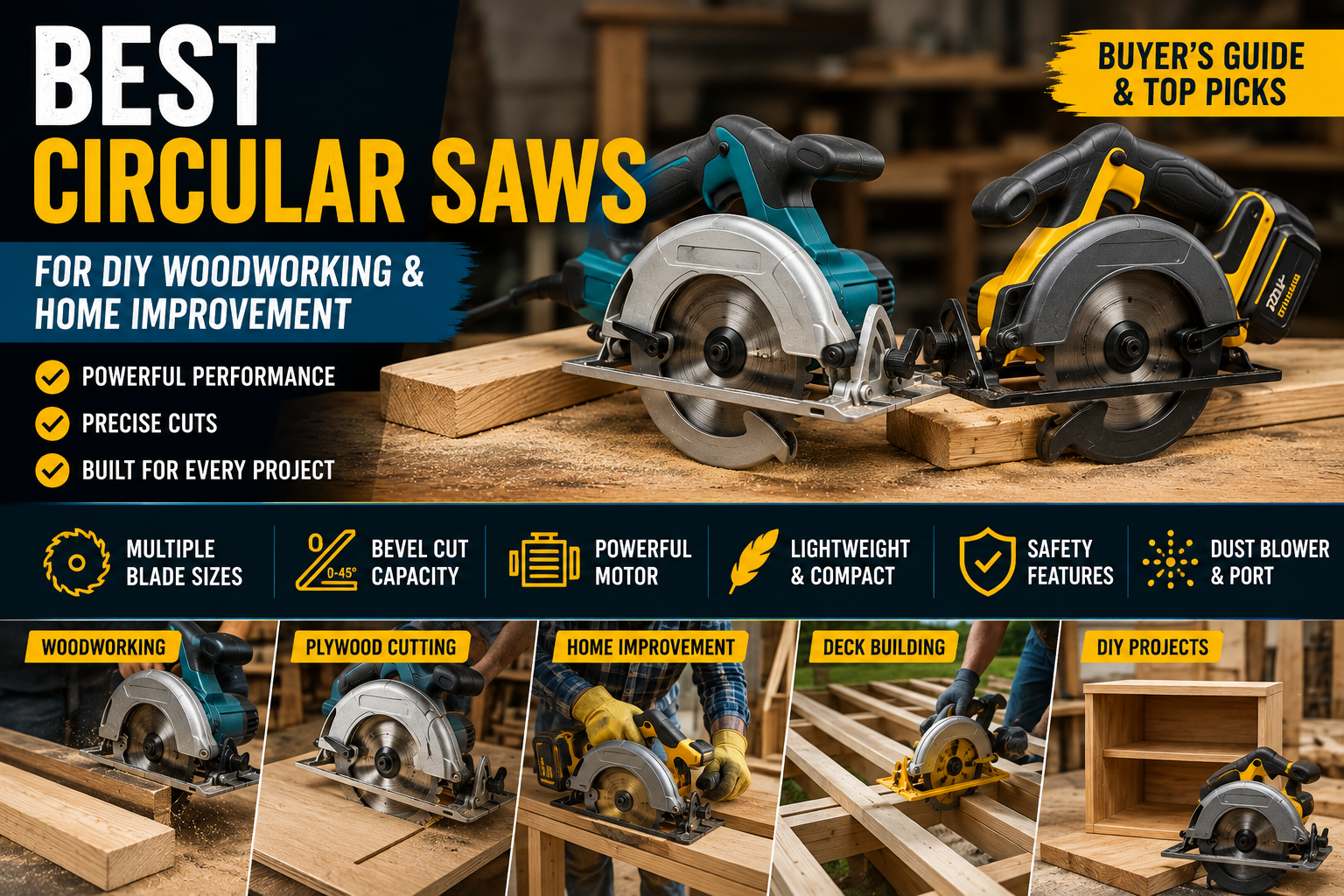
A circular saw is one of the most useful cutting tools for homeowners, DIY enthusiasts, woodworkers, and anyone working on home improvement projects. Whether you are cutting lumber for a small construction project, trimming plywood, building shelves, repairing a deck, or working on a larger renovation, the right circular saw can make the job considerably easier.
But choosing a circular saw is not as simple as picking the most powerful model or the most expensive option.
The best circular saw for you depends on the type of material you cut, how often you use the tool, whether you prefer cordless or corded operation, the blade size you need, how much control you want, and the type of projects you normally handle.
Quick answer: For general DIY and home improvement, look for a circular saw that offers a comfortable design, suitable cutting depth, reliable blade control, easy-to-use safety features, and a power system that matches your workload. Cordless models are excellent for portability, while corded models can be useful for long periods of continuous work.
This guide explains what to look for in a circular saw, which features actually matter, and how to choose the right type for woodworking, home improvement, construction, and DIY projects.
What Is a Circular Saw?
A circular saw is a handheld power tool that uses a rotating circular blade to cut through materials.
The blade spins at high speed while the user guides the saw through the workpiece. A flat base, often called a shoe or base plate, helps support the tool while cutting.
Circular saws are commonly used for:
- Lumber
- Plywood
- Wooden boards
- Framing
- Decking
- Shelving
- Flooring
- General woodworking
- Home renovation
- Construction projects
- Sheet materials
The tool is especially useful when you need a relatively straight and controlled cut.
Unlike a reciprocating saw, which uses a blade moving back and forth, a circular saw uses a rotating blade. That difference makes the two tools useful for very different jobs.
If you are unsure which one fits your project, our guide to Circular Saw vs. Reciprocating Saw can help you compare the two cutting tools.
Why Choose a Circular Saw?
A circular saw offers a combination of speed, portability, and cutting capability that makes it useful for both beginners and experienced DIYers.
One of its biggest advantages is its ability to make long cuts through boards and sheet materials without requiring a large stationary machine.
For example, imagine that you need to cut a sheet of plywood into smaller sections.
A circular saw can be positioned on the material and guided along a marked cutting line. With the right technique and an appropriate guide, you can produce consistent results much more efficiently than using a traditional handsaw.
Circular saws are also useful because they can be relatively compact compared with larger workshop saws.
For homeowners who do not have space for a permanent woodworking setup, that portability can be extremely valuable.
Best Circular Saw for DIY: What Should You Look For?
There is no single circular saw that is perfect for everyone.
Instead, the best choice depends on several important factors.
The most useful specifications and features to consider include:
- Blade size
- Cutting depth
- Motor performance
- Corded or cordless operation
- Battery platform
- Bevel capacity
- Ergonomics
- Weight
- Blade visibility
- Safety features
- Dust management
- Build quality
- Ease of blade changes
Let’s look at each one.
1. Blade Size
Blade diameter is one of the first specifications you will notice when comparing circular saws.
Different blade sizes are designed for different cutting requirements.
Common categories include compact saws and larger general-purpose models.
A larger blade can generally provide greater cutting depth, while a compact blade can make a tool lighter and easier to handle.
However, bigger does not automatically mean better.
If you mainly build small shelves, perform light repairs, or work with relatively thin materials, a compact circular saw may be easier to control.
If you regularly cut thicker lumber or work on construction projects, a larger blade format may be more appropriate.
The correct blade size is therefore the one that matches the material you actually work with.
2. Cutting Depth
Cutting depth tells you how deeply the blade can cut into a material under specified conditions.
This is an important consideration because your saw needs to be capable of cutting through the material you normally use.
For example, if your projects involve thicker boards, you should pay close attention to the saw’s maximum cutting depth.
However, maximum cutting depth can vary depending on factors such as:
- Blade size
- Cutting angle
- Tool configuration
- Material
- Manufacturer specifications
When comparing products, always check the manufacturer’s stated cutting capacity rather than assuming that two saws with similar-looking blades will provide identical results.
3. Corded vs. Cordless Circular Saws
One of the biggest decisions is whether to choose a corded or cordless circular saw.
Both have advantages.
Cordless Circular Saws
Cordless models run from rechargeable batteries.
Their biggest advantage is freedom of movement.
You can work:
- Outside
- In a garage
- On a construction site
- In a garden
- Away from electrical outlets
- In locations where managing an extension cord would be inconvenient
For homeowners, portability can make a cordless circular saw extremely convenient.
Advantages
- Excellent mobility
- No power cable
- Easy setup
- Convenient outdoor use
- Useful for remote work areas
Limitations
- Battery needs charging
- Runtime depends on the battery and workload
- Batteries add weight
- Replacement batteries can increase the overall cost
Corded Circular Saws
Corded models receive power directly from an electrical outlet.
This can be useful when you are working in one location for an extended period.
Advantages
- Continuous electrical power
- No battery charging
- Suitable for long work sessions
- Often convenient for workshop environments
Limitations
- Requires an electrical outlet
- Extension cords may be necessary
- Less convenient for outdoor or remote work
- Cable management can become annoying
Which one should you choose?
If portability is your priority, choose cordless.
If you mainly work in a fixed workshop and expect long cutting sessions, a corded model may make more sense.
4. Brushless vs. Brushed Motors
Motor design is another factor worth considering.
Many modern cordless power tools are available with brushless motors.
Brushless Motors
Brushless motor systems use electronic controls instead of traditional physical brushes.
They are often valued for:
- Efficiency
- Reduced mechanical wear
- Lower maintenance requirements
- Good battery utilization
- Modern motor design
This can make brushless tools attractive to frequent users.
Brushed Motors
Brushed motors use physical brushes as part of their operation.
They have been used in power tools for decades and can still be perfectly suitable for many DIY applications.
For someone who only uses a circular saw occasionally, buying a brushless model is not automatically necessary.
The practical answer
If you use your saw frequently, a brushless model may be worth considering.
If you use it occasionally, focus first on the tool’s overall suitability, ergonomics, cutting capacity, and price.
5. Bevel Capacity
A circular saw is not limited to straight 90-degree cuts.
Many models allow the base to tilt so the blade can make angled cuts.
This is known as bevel cutting.
Bevel capability can be useful for:
- Framing
- Trim work
- Roofing-related projects
- Furniture construction
- Decorative woodworking
- Home renovation
If you frequently make angled cuts, check how easily the bevel adjustment works.
A good adjustment mechanism should be simple to understand and secure once set.
6. Ergonomics and Comfort
A circular saw may look simple, but its handling characteristics matter enormously.
You may need to hold the tool for extended periods, make repeated cuts, or work from different positions.
A comfortable design can reduce fatigue and improve control.
Look for:
- Comfortable handles
- Balanced weight distribution
- Easy-to-reach controls
- Secure grip
- Clear sight lines
- Convenient trigger placement
A slightly lighter tool may be preferable for frequent DIY work.
On the other hand, a heavier design may feel more substantial for certain applications.
The right balance depends on the user.
7. Weight
Weight becomes particularly important when making multiple cuts.
A heavy circular saw can become tiring when you are working overhead, climbing stairs, or carrying the tool between locations.
A compact saw can be easier to maneuver.
But extremely light does not automatically mean better.
The tool still needs enough stability and power for the material you intend to cut.
Think of weight as part of the overall balance between:
power + control + comfort + portability.
8. Blade Visibility
Being able to clearly see where the blade is going can make a major difference.
When cutting along a marked line, the user needs to maintain control and understand where the cut is progressing.
A well-designed saw should provide a useful sightline around the blade area.
Some models may also incorporate additional features intended to improve visibility.
When comparing tools, do not focus exclusively on motor specifications. Consider how easy the saw is to guide.
9. Safety Features
A circular saw is a powerful cutting tool, so safety should be part of the buying decision.
Useful features may include:
- Blade guards
- Secure trigger mechanisms
- Electric braking systems on applicable models
- Stable base plates
- Clear operating controls
- Secure bevel adjustment
- Good grip surfaces
Always read the manufacturer’s safety instructions before operating the tool.
Never remove or disable protective components simply because they make a task more convenient.
10. Dust and Debris Management
Cutting wood produces dust and debris.
Depending on your workspace, dust management can be important for both visibility and cleanup.
Some circular saws offer dust extraction compatibility or features designed to direct debris away from the cutting area.
If you frequently work indoors, consider how you will manage sawdust before buying your tool.
A cleaner work area can make measurements and cutting lines easier to see.
What Is the Best Circular Saw for Woodworking?
For woodworking, precision and control are often more important than simply having maximum power.
When choosing a circular saw for woodworking, consider:
- Blade quality
- Cutting depth
- Bevel adjustment
- Ergonomics
- Base stability
- Blade visibility
- Ease of adjustment
If you frequently work with plywood, boards, and dimensional lumber, a general-purpose circular saw can be a useful addition to your workshop.
For more specialized woodworking, however, a table saw, track saw, miter saw, or other dedicated tool may sometimes be better suited to the job.
A circular saw is extremely versatile, but it should not be expected to replace every type of cutting machine.
What Is the Best Circular Saw for Home Improvement?
For general home improvement, versatility is usually the priority.
A homeowner may use the tool for one project today and something completely different several months later.
For that reason, look for a model that offers:
- Reliable cutting performance
- Easy blade changes
- Comfortable handling
- Suitable cutting depth
- Useful bevel adjustment
- Good safety features
- Appropriate power for your typical materials
A cordless model can be especially convenient if you work around the house, garage, yard, or outdoor structures.
What Is the Best Circular Saw for Beginners?
Beginners should prioritize control over headline specifications.
A first circular saw should ideally be:
- Comfortable to hold
- Easy to adjust
- Simple to operate
- Appropriate for common DIY materials
- Easy to maintain
- Supported by readily available blades
A beginner does not necessarily need the most powerful professional-grade saw available.
Learning how to safely measure, support, guide, and cut material is more important than buying the most expensive tool.
Circular Saw Blade Selection Matters
A common mistake is to focus heavily on the saw while ignoring the blade.
The blade is the part that actually interacts with the material.
Different blades can be designed for different purposes.
For example:
General-purpose wood blade
Useful for everyday wood-cutting tasks.
Fine-tooth blade
Can be useful when a cleaner finish is important.
Framing blade
Designed for construction-oriented wood cutting.
Specialized material blades
Certain applications may require blades specifically designed for particular materials.
Before installing a blade, make sure it is compatible with your circular saw and suitable for the material and application.
Never assume that one blade is appropriate for every job.
How Many Teeth Should a Circular Saw Blade Have?
Tooth count is an important blade characteristic, but there is no universal “best” number.
A lower tooth count can be associated with faster, more aggressive cutting in some applications.
A higher tooth count can be useful when a smoother finish is more important.
The right choice depends on:
- Material
- Desired finish
- Cutting speed
- Blade design
- Saw type
- Project requirements
Rather than memorizing one number, think about the result you want.
Fast rough cut?
A blade designed for speed may be appropriate.
Cleaner finished cut?
A blade designed for a finer finish may be more suitable.
Circular Saw vs. Reciprocating Saw
These two tools are often compared because both are handheld cutting tools.
But their purposes are different.
| Task | Circular Saw | Reciprocating Saw |
|---|---|---|
| Long straight cuts | Excellent | Limited |
| Plywood | Excellent | Poor choice |
| Lumber | Excellent | Good |
| Demolition | Good | Excellent |
| Pipes | Limited | Excellent |
| Pruning | Not recommended | Excellent with suitable blade |
| Tight spaces | Limited | Excellent |
| Precision | Excellent | Moderate |
| Rough cutting | Good | Excellent |
If you need controlled straight cuts, choose the circular saw.
If you need flexible cutting in awkward locations, consider a reciprocating saw.
For a more detailed comparison, read our Circular Saw vs. Reciprocating Saw guide.
Should You Buy a Compact Circular Saw?
Compact circular saws can be attractive to DIY users who prioritize portability and ease of handling.
They may be particularly useful for:
- Small woodworking projects
- Light home repairs
- Shelving
- Craft projects
- Thin materials
- Occasional DIY work
The main question is whether the compact format provides enough cutting capacity for your projects.
If your typical work involves thicker lumber, large sheets, or demanding construction tasks, check the tool’s specifications carefully before choosing a compact model.
Should You Buy a Cordless Circular Saw?
A cordless circular saw can be a very practical choice if you value mobility.
It can be especially useful when:
- You work outdoors
- You move between rooms
- You work on construction sites
- You already own compatible batteries
- You do not want to manage extension cords
If you already own other cordless tools, consider staying within the same battery ecosystem when practical.
This can allow you to share batteries between compatible tools.
However, always verify exact battery compatibility before purchasing.
How to Choose the Right Circular Saw for Your Project
Use this simple decision process.
Step 1: Identify your material
Are you mainly cutting:
- Lumber?
- Plywood?
- Boards?
- Flooring?
- Other materials?
Start with the material.
Step 2: Determine the required cutting depth
Choose a saw capable of handling the thickness of the materials you commonly use.
Step 3: Decide between corded and cordless
Ask yourself whether mobility or continuous operation is more important.
Step 4: Consider blade size
Choose a blade format that matches your cutting requirements.
Step 5: Think about comfort
If you expect frequent use, ergonomics matter.
Step 6: Check bevel capability
If angled cuts are part of your projects, make sure the saw provides the adjustment range you need.
Step 7: Consider your existing battery system
If you already own cordless tools, compatibility can influence the best purchase.
Step 8: Think about future projects
Do not choose a tool only for today’s project.
Consider what you are likely to build or repair over the next few years.
Recommended Circular Saw Buying Priorities
If you are overwhelmed by specifications, use this priority list.
For beginners
Prioritize:
- Safety
- Comfort
- Ease of use
- Suitable cutting depth
- Reliable blade compatibility
- Reasonable price
For DIY enthusiasts
Prioritize:
- Versatility
- Ergonomics
- Cutting performance
- Bevel capability
- Blade availability
- Battery ecosystem
For frequent users
Prioritize:
- Build quality
- Motor efficiency
- Ergonomics
- Battery performance or continuous power
- Cutting capacity
- Durability
- Long-term support
Common Circular Saw Buying Mistakes
Buying a circular saw can be surprisingly easy to get wrong.
Here are some common mistakes to avoid.
Buying Based Only on Power
More power is not automatically better.
The tool still needs to be comfortable, controllable, and appropriate for the material.
Ignoring the Blade
The right blade can dramatically affect cutting performance.
Choosing the Wrong Size
A huge saw may be unnecessary for light DIY work.
A compact saw may be insufficient for demanding construction projects.
Forgetting Battery Costs
A cordless tool may look affordable until you discover that the battery and charger are sold separately.
Check what is included before purchasing.
Ignoring Ergonomics
A tool that looks impressive on paper can still be uncomfortable in your hands.
Buying Without Thinking About Future Projects
A circular saw can last for years.
Choose based on your expected use rather than a single weekend project.
Our Approach to Choosing a Circular Saw
At SmallEasyTools, the goal should not be to tell every reader that the same product is “the best.”
Instead, products should be evaluated according to different use cases.
For example:
Best for beginners: prioritize simplicity and control.
Best for portability: prioritize compact design and cordless operation.
Best for frequent DIY: prioritize durability, ergonomics, and versatility.
Best for woodworking: prioritize cutting control, blade compatibility, and bevel adjustment.
Best for larger projects: prioritize cutting capacity, power, and long-term usability.
This approach gives readers a more useful answer than simply listing products from the highest price to the lowest.
Where to Find the Right Circular Saw
If you are ready to compare actual models, browse the SmallEasyTools Power Tools collection and look for circular saws that match your project requirements.
Before choosing a specific product, compare:
- Blade size
- Cutting capacity
- Power system
- Included accessories
- Battery and charger availability
- Weight
- Bevel adjustment
- Intended use
Do not choose a product simply because it has the highest specification.
Choose the model that solves your particular problem.
Final Verdict
So, what is the best circular saw for DIY woodworking and home improvement?
There is no single answer.
The best circular saw is the one that matches your materials, cutting requirements, experience level, and working environment.
For general DIY, prioritize comfort, control, versatility, and suitable cutting capacity.
For woodworking, focus more heavily on precision, blade selection, stability, and bevel adjustment.
For outdoor and mobile work, a cordless circular saw can provide excellent freedom of movement.
For long periods of workshop use, a corded circular saw may be more convenient because it does not depend on battery runtime.
And if you already own cordless tools, a compatible battery platform can make a new purchase more practical.
The smartest buying decision is not necessarily the most powerful or expensive option.
It is the tool you can control comfortably, use safely, and rely on for the projects you actually perform.
A good circular saw should make your work easier—not make your tool collection more complicated.
Frequently Asked Questions
What is the best circular saw for DIY projects?
The best circular saw for DIY depends on the type of work you perform. For general home projects, look for a comfortable, versatile model with suitable cutting depth, easy adjustments, good blade visibility, and appropriate power.
Is a cordless circular saw better than a corded model?
Neither is universally better. Cordless models provide excellent mobility and are convenient for outdoor work, while corded models can be useful for long periods of continuous cutting near an electrical outlet.
What size circular saw should a beginner buy?
The appropriate size depends on the materials you intend to cut. A compact model can be convenient for light DIY work, while a larger general-purpose format may be more appropriate for thicker lumber and construction projects.
Can a circular saw cut plywood?
Yes. Circular saws are commonly used for cutting plywood. The blade should be appropriate for the material and the desired finish, and the sheet should be properly supported during cutting.
Can a circular saw cut thick wood?
A circular saw can cut wood within the cutting capacity specified by the manufacturer. Before starting a project, check the saw’s maximum cutting depth for the blade size and cutting angle you plan to use.
Is a brushless circular saw worth it?
A brushless model can be attractive to frequent cordless-tool users because of its motor design and potential efficiency advantages. Occasional DIY users may find that other factors such as comfort, cutting capacity, and price are more important.
What circular saw blade is best for wood?
The best blade depends on the type of woodwork and the desired finish. General-purpose blades can be useful for everyday cutting, while blades designed for finer cuts may be preferable when appearance matters.
How do I choose a circular saw blade?
Start with the material, desired finish, blade compatibility, and cutting requirements. Make sure the blade is specifically suitable for your circular saw and intended application.
Can a circular saw replace a table saw?
A circular saw can perform many cutting tasks, but it does not completely replace a table saw. A table saw can provide a different level of repeatability and support for certain woodworking applications.
Should I buy a circular saw or reciprocating saw?
Choose a circular saw if you need straight, controlled cuts in materials such as lumber and plywood. Choose a reciprocating saw if you expect to perform demolition, pipe cutting, pruning, or work in tight spaces.
Related SmallEasyTools Guides
If you are building a complete DIY tool collection, these guides can help you choose the right equipment for different jobs:
- Circular Saw vs. Reciprocating Saw: Which One Do You Need?
- Best Cordless Reciprocating Saws for DIY & Home Projects
- Best Power Tools for Home DIY Projects
- Best Drill Bits for Concrete, Brick, Masonry & Tile
- Best Drill Accessories for Homeowners and DIYers
As these guides are published, connect them with contextual internal links rather than placing every link in a generic “related posts” section. This creates a clearer topic relationship for both readers and search systems.
Safety Disclaimer
Power tools can cause serious injury when used incorrectly. Always read and follow the manufacturer’s instructions, use appropriate personal protective equipment, inspect the tool and blade before use, secure the workpiece properly, and keep the cutting area clear before operating a circular saw.
Affiliate Disclosure
SmallEasyTools may earn a commission when you purchase products through qualifying affiliate links. This does not increase the price you pay and helps support the website and its content.