



















Best Cordless Reciprocating Saws for DIY & Home Projects

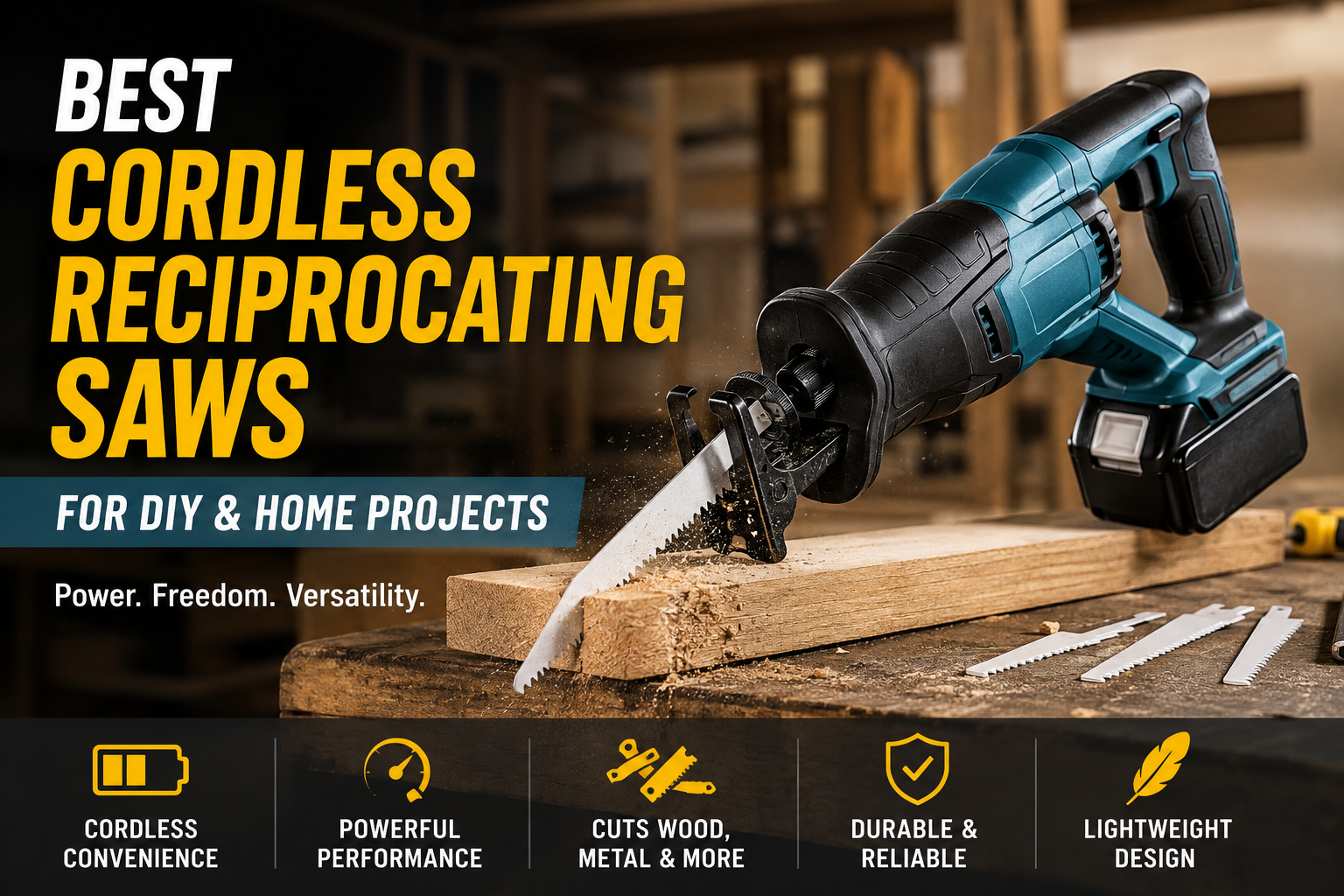
If you regularly work on home improvement, woodworking, renovation, pruning, or demolition projects, a reciprocating saw can quickly become one of the most useful tools in your workshop. Unlike a traditional handsaw, a reciprocating saw uses a rapidly moving blade to cut through materials with less physical effort. And when you choose a cordless model, you get the added freedom to work without being tied to a power outlet.
But with so many cordless reciprocating saws available, choosing the right model can be difficult. Battery voltage, brushless motors, stroke length, strokes per minute, ergonomics, vibration control, blade compatibility, and battery systems can all affect performance.
This guide explains what to look for when choosing a cordless reciprocating saw and how to find the right option for your DIY and home improvement projects.
What Is a Cordless Reciprocating Saw?
A reciprocating saw is a power tool that moves a blade back and forth at high speed. This reciprocating motion allows the blade to cut through materials such as wood, plastic, drywall, pipes, branches, and certain types of metal.
A cordless reciprocating saw operates using a rechargeable battery rather than a direct electrical connection. This makes it especially convenient for outdoor work, renovation projects, demolition, plumbing, and areas where access to electricity is limited.
Because the blade is generally exposed at the front of the tool, a reciprocating saw can also reach places where larger cutting tools may be difficult to use.
Why Choose a Cordless Reciprocating Saw?
The biggest advantage of a cordless reciprocating saw is mobility.
A corded saw may provide consistent power, but you need to stay close to an electrical outlet or use an extension cord. With a cordless model, you can move around your workspace freely.
Key advantages include:
- Easy portability
- No power cord to manage
- Convenient for outdoor projects
- Useful for demolition
- Suitable for pruning branches
- Easier access to tight areas
- Quick setup
- Compatible with different blade types
For homeowners and DIY users, cordless models are often particularly convenient because they can be stored and used without preparing a permanent workshop setup.
What Can You Cut With a Cordless Reciprocating Saw?
One of the reasons reciprocating saws are so popular is their versatility. The saw itself is only part of the equation; the blade determines what material you can safely and effectively cut.
Depending on the blade, a cordless reciprocating saw can be used for:
Wood
Wood-cutting blades are useful for framing, construction, remodeling, and general DIY work.
You can use a reciprocating saw to cut dimensional lumber, wooden boards, branches, and other wood materials. For straight, highly precise cuts, however, a circular saw may be a better choice.
Metal
With an appropriate metal-cutting blade, a reciprocating saw can cut through pipes, metal studs, brackets, screws, and other metal components.
The correct blade is essential. Using a blade designed for wood on metal can result in poor performance and premature blade wear.
Plastic and PVC
Reciprocating saws can also be useful for cutting plastic pipes and PVC during plumbing or renovation projects.
A suitable fine-tooth blade can help produce a cleaner cut.
Drywall
A reciprocating saw can be useful for making openings during remodeling. However, care should be taken around electrical wiring, plumbing, and structural components hidden behind walls.
Tree Branches
With a pruning blade, a cordless reciprocating saw can become a useful outdoor tool.
It can be particularly helpful for removing branches that are too thick for ordinary pruning shears.
Cordless vs. Corded Reciprocating Saws
One of the most common questions is whether you should buy a cordless or corded reciprocating saw.
There is no universal winner. The better option depends on how you plan to use the tool.
| Feature | Cordless Reciprocating Saw | Corded Reciprocating Saw |
|---|---|---|
| Portability | Excellent | Limited |
| Outdoor use | Excellent | Requires extension cord |
| Power consistency | Depends on battery | Consistent |
| Setup | Very easy | Requires power connection |
| Long continuous work | Battery dependent | Excellent |
| Tight spaces | Convenient | Cord can get in the way |
| DIY projects | Excellent | Excellent |
| Construction sites | Excellent | Useful near outlets |
For occasional home projects, a cordless reciprocating saw is often more convenient.
For long periods of continuous cutting where electricity is readily available, a corded model can still make sense.
Brushless vs. Brushed Motors
Another important decision is the type of motor.
Brushed Motors
Brushed motors have been used in power tools for many years. They are generally simpler and can make cordless tools more affordable.
However, brushes are wear components. Over time, they can require replacement.
Brushless Motors
Brushless motors use electronic controls rather than traditional carbon brushes.
Modern brushless cordless tools are popular because they can offer:
- Improved efficiency
- Longer motor life
- Reduced maintenance
- Better battery utilization
- Strong performance under load
If you use your reciprocating saw frequently, a brushless model can be worth considering.
For occasional DIY work, however, a brushed model may provide enough performance without the higher purchase price.
Understanding Battery Voltage
Cordless reciprocating saws are commonly sold in different battery voltage classes.
You may encounter models marketed around:
- 12V
- 18V
- 20V
- 24V
- Higher-voltage systems
A higher voltage does not automatically mean a tool is better for every user.
For light DIY work, a compact lower-voltage model can be easier to handle.
For demanding cutting and demolition, a higher-performance battery platform may be preferable.
Another important factor is whether you already own batteries from the same tool ecosystem.
If you already use several cordless tools from a particular manufacturer, buying a bare-tool reciprocating saw that uses the same battery system can save money.
Stroke Length: Why Does It Matter?
Stroke length refers to how far the blade travels backward and forward during each cycle.
A longer stroke can help remove more material with each movement and may improve cutting speed in certain applications.
However, longer is not always better.
For detailed or controlled work, a shorter stroke can sometimes provide better handling.
When comparing models, consider stroke length together with:
- Stroke speed
- Motor performance
- Blade quality
- Material being cut
- Operator control
Looking at one specification in isolation can give you an incomplete picture.
Strokes Per Minute
Strokes per minute, often abbreviated as SPM, describes how many times the blade moves back and forth during a minute.
Higher SPM can help with certain cutting applications, but maximum speed is not the only consideration.
Different materials require different blade speeds and tooth configurations.
For example, aggressive wood cutting may benefit from a different blade and speed combination than cutting thin metal.
Variable-speed control is therefore a useful feature for DIY users because it provides more control over different materials.
Variable Speed Control
Variable-speed triggers allow you to control the blade speed depending on how you are cutting.
This can be useful when:
- Starting a cut
- Working with delicate materials
- Cutting metal
- Making controlled cuts
- Preventing excessive vibration
Instead of immediately running the tool at maximum speed, you can gradually increase speed as the blade enters the material.
Tool Weight and Ergonomics
A reciprocating saw can become tiring if you hold it for a long time.
Weight matters even more when you are cutting overhead, working on a ladder, or holding the tool at an awkward angle.
Look for a model with:
- Comfortable grip
- Balanced weight distribution
- Non-slip handle
- Easy-to-reach controls
- Reasonable overall weight
A slightly less powerful saw that you can comfortably control may be more useful than a heavier model with higher specifications.
Vibration Control
Reciprocating saws naturally produce significant movement because the blade moves back and forth rapidly.
Some models include vibration-reduction systems or improved internal balancing.
This can make a noticeable difference during extended use.
Reduced vibration may help improve:
- Comfort
- Control
- Cutting accuracy
- User fatigue
If you expect to use the saw regularly, vibration management is a feature worth considering.
Blade Compatibility
Before purchasing a cordless reciprocating saw, check what type of blades it accepts.
Fortunately, many reciprocating saws use widely available blade designs, but compatibility should still be confirmed before purchasing replacement blades.
Different blades are designed for different jobs.
Common blade types include:
Wood blades:
Designed for faster cutting through wood and similar materials.
Metal blades:
Usually have finer teeth and are designed for cutting metal.
Pruning blades:
Designed for branches and outdoor cutting.
Demolition blades:
Built for demanding applications where durability is important.
Bi-metal blades:
Combine different materials to provide a balance of flexibility, durability, and cutting performance.
Using the right blade can make a bigger difference than simply choosing a more powerful saw.
Safety Tips for Using a Reciprocating Saw
Power tools can be extremely useful, but they should always be handled responsibly.
Before using a cordless reciprocating saw:
- Wear appropriate eye protection.
- Use hearing protection when necessary.
- Make sure the blade is properly installed.
- Inspect the blade before cutting.
- Secure loose materials.
- Keep both hands positioned safely.
- Be aware of hidden wiring and plumbing.
- Allow the blade to stop before setting the tool down.
- Keep the battery removed when performing maintenance or changing blades.
- Follow the manufacturer’s operating instructions.
When cutting walls, pipes, or other concealed areas, always consider what may be located behind the material.
How to Choose the Best Cordless Reciprocating Saw
Instead of choosing a saw based solely on brand or price, think about your actual projects.
For occasional DIY
Look for:
- Comfortable design
- Moderate power
- Variable speed
- Affordable battery system
- Easy blade replacement
For remodeling
Consider:
- Higher cutting performance
- Good battery capacity
- Durable construction
- Vibration control
- Multiple compatible blades
For demolition
Prioritize:
- Strong motor
- Durable blade system
- Long battery runtime
- Good ergonomics
- High-quality construction
For pruning
Look for:
- Lightweight design
- Good balance
- Compatible pruning blades
- Easy handling
- Sufficient battery life
What Battery Capacity Should You Choose?
Battery capacity is generally expressed in amp-hours, or Ah.
A higher-capacity battery can provide more runtime, although actual runtime depends on the material, blade, tool design, and workload.
For occasional household projects, a smaller battery may be sufficient.
For demanding or extended jobs, a higher-capacity battery can reduce interruptions.
If you already own compatible batteries, buying a tool-only version may be a cost-effective option.
Our Buying Advice
There is no single best cordless reciprocating saw for everyone.
The best model depends on your work.
If you mainly perform small DIY projects, prioritize comfort, portability, and affordability.
If you frequently remodel or perform demolition work, look for a more powerful brushless model with good battery capacity and durable construction.
If your main use is pruning, choose a lighter model with appropriate pruning blades.
The most expensive tool is not necessarily the best choice. The goal is to match the tool’s capabilities with your actual needs.
Final Thoughts
A cordless reciprocating saw is one of the most versatile cutting tools a DIY enthusiast or homeowner can own. Its combination of portability, cutting power, and blade flexibility makes it useful for everything from woodworking and renovation to plumbing, demolition, and pruning.
When choosing a model, look beyond the headline specifications. Consider the motor type, battery platform, stroke length, strokes per minute, variable-speed control, ergonomics, vibration, blade compatibility, and the type of work you actually expect to perform.
If you already own cordless tools from a particular battery ecosystem, staying within that platform can also be a smart way to reduce the overall cost of building your tool collection.
Most importantly, choose the tool based on the job—not simply the highest voltage, highest speed, or most expensive price tag.
With the right blade and proper technique, a good cordless reciprocating saw can become a reliable addition to almost any home workshop or DIY toolkit.
Frequently Asked Questions
Is a cordless reciprocating saw good for home use?
Yes. A cordless reciprocating saw can be an excellent option for homeowners because it is portable and does not require a nearby electrical outlet. It can be used for woodworking, remodeling, pruning, demolition, and cutting pipes when the appropriate blade is installed.
Can a reciprocating saw cut wood?
Yes. Reciprocating saws can cut wood effectively when equipped with an appropriate wood-cutting blade. However, a circular saw is generally better when you need long, straight, highly precise cuts.
Can a cordless reciprocating saw cut metal?
Yes. With a suitable metal-cutting blade, a reciprocating saw can cut various metal materials. Always select a blade designed for the specific material and thickness.
Is brushless better than brushed for a reciprocating saw?
A brushless motor can offer efficiency, durability, and lower maintenance, making it attractive for frequent users. For occasional DIY work, a brushed motor can still provide adequate performance at a potentially lower cost.
How long does a cordless reciprocating saw battery last?
Battery runtime varies considerably depending on battery capacity, material, blade, cutting technique, and workload. A larger battery generally provides more runtime, but actual performance differs between tools and applications.
Can I use a reciprocating saw for tree branches?
Yes. With a suitable pruning blade, a reciprocating saw can be useful for cutting branches. Make sure the branch is stable and use appropriate safety precautions.
Should I buy a cordless or corded reciprocating saw?
For portability and outdoor work, cordless models are usually more convenient. For long periods of continuous cutting near an electrical outlet, a corded model can provide consistent power without battery limitations.
Disclosure: SmallEasyTools may earn a commission when you purchase products through qualifying affiliate links. This does not affect the price you pay and helps support the website.
Safety Note: Always read and follow the manufacturer’s instructions and safety recommendations before operating any power tool.